 Singularity Audio Labs · Studio Suite v3.0 (
singularitylabs.music)
Where Conventional Audio Rules Break Down.
Plugins That Listen to Both Ends of the Wire—And Negotiate Together as a Closed-Loop Studio Team.
Next-generation Audio Unit (AU) processors for Apple Logic Pro that combine classic analog hardware character with closed-loop acoustic intelligence, 5-step & 9-step multi-plugin negotiation, multi-track drum & bass bus networking, and modeled subterranean studio chambers.
The Vision: Studio-Grade Hardware That Hears What It’s Doing
Conventional “smart” audio plugins only measure incoming volume once and guess a static preset—completely blind to what the processor actually does to the sound on the way out, and oblivious to other plugins on the same track or across your mix buses. Singularity Audio Labs solves this with four core innovations:
Input ↔ Output Awareness
Every processor continuously compares what enters the plugin against what leaves it—turning its own physical controls like motorized console faders until the output matches the punch, sustain, clarity, and tonal balance of your selected style.
⚡ TEAM LINK Co-Op Chains
Our EQ separates surgical problem sweeping from musical voicing in a 5-Step Duo Chain (`2.25s`), and scales to a 9-Step, 3-Pass Trio Protocol (`2.70s`) when stacking `EQ + Fast 1176 FET + Slow Opto/Vari-Mu`—with zero unanswered moves.
🥁 DRUM LINK Network Mode
Using `< 40 ns` lock-free shared memory (`zero DAW sidechain routing`), plugins across Kick, Snare, Toms, Overheads, Room, All-Drums Bus, and Bass Bus allocate staggered frequency pockets and shield cymbal bleed automatically.
🏛️ Studio Chambers & Stem DNA
Backed by 38 genre/instrument profiles and our new Singularity ChamberVerb (modeling Capitol Underground Chambers, Abbey Road STEED, EMT 140 Plate & Headley Grange Stairwell) with blind-dereverberation Reference Stem Learning.
 Live & Validated (`SG76`)
 Live & Validated (`SGEQ`)
 Live & Validated (`SGIM`)
 New Flagship (`SGCV`)
 Live & Validated (`SGSp`)
 v3 Bus Network (`SGSV`)
Complete Studio Lineup — What Each Processor Does & Live 2x Retina Interfaces
What It Does: An intelligent analog-modeled compressor that listens to both your incoming performance and its own compressed output—automatically turning its physical Drive, Attack, Release, and Makeup knobs like motorized console faders until your track locks into the pocket. Includes 4 classic hardware topologies (Rev A Blue Stripe, Rev D/E Blackface, Opto Tube, and VCA Bus), All-Buttons-In “British Mode,” 5-Step / 9-Step ⚡ TEAM LINK, and 🥁 DRUM LINK bleed protection.

What It Does: A full-spectrum (`20 Hz – 20 kHz`) 8-band zero-delay-feedback equalizer that executes a Surgical Problem Sweep first (Step 1) to remove boom, boxiness, and harsh glare with sub-Hertz skirt-matched $Q$, then shapes Initial Style Voicing second (Step 2) on the cleaned signal. Protects musical fundamentals with a 12-harmonic Note Shield and carves staggered drum/bass pockets via 🥁 DRUM LINK.

What It Does: Combines Vari-Mu 670 Tube, VCA Mastering Bus, and Optical Mastering compression with physical Jiles-Atherton Nickel / Iron / Steel transformer saturation, an Elliptical Mid/Side Bass Mono-Maker, and Full-Master Reference Track Ingestion (`LEARN REF`) with Bayesian Limiter De-Biasing across our 5-Module, 15-Turn Mastering Transfer Desk.

What It Does: Models 6 legendary physical recording spaces—Capitol Underground Chambers 2 & 4, Abbey Road Studio 2 (STEED), EMT 140 Tube Plate, Sunset Sound Live Room, and Headley Grange 3-Story Stone Stairwell. Listens in closed loop to dial in Haas Pre-Delay, $RT_{60}(f)$, $C_{80}$ clarity, and dynamic tail ducking—plus Reference Stem Space Learning from any finished track.

What It Does: A hyper-visual 1-to-5 tap stereo delay and spatial echo designer. Sculpt exact delay times (`10 ms – 2000 ms`), place each tap anywhere across a constant-power stereo panorama, and shape rhythmic cascades or accelerating “bouncing ball” echoes on a 60fps interactive 2D sonar stage—complete with analog tape saturation and high/low feedback damping.

What It Does: Connects Singularity EQs, Compressors, and ChamberVerbs across 8 Drum & Bass Roles (Kick, Snare, Rack Tom, Floor Tom, Overheads, Room, All-Drums Bus, and Bass Bus) via `< 40 ns` POSIX shared memory. Separates drum & bass fundamentals, shields snare/tom gates from cymbal wash, and back-propagates parent bus glue commands automatically.

Singularity Adaptive 1176 — The Compressor That Knows What a Guitar Should Sound Like
Select your instrument and style—such as Guitar: Rhythm Crunch, Guitar: Clean / Funk Snap, or Guitar: Lead Sustain. The compressor listens to the incoming performance and its own analog-modeled output, smoothly turning its physical Drive, Attack, Release, and Makeup dials until the output sits right in the pocket.
Two Iconic Hardware Flavors
Switch seamlessly between the aggressive bite and Class-A warmth of the vintage Blue Stripe and the smooth, punchy articulation of the studio-classic Blackface—including authentic All-Buttons-In (“British Mode”) overdrive.
Closed-Loop Target Analyzer
Real-time visual gauges show Dynamic Control, Pick/Transient Snap Preservation, and Pocket Recovery—so you can see why the compressor chose every setting.
Visible Motorized Knob Motion
Instead of invisible black-box processing, the physical 1176 knobs glide smoothly across the screen like motorized console faders as decisions are made, giving you 100% manual override at any time.
⚡ TEAM LINK — 5-Step Duo Chain (`2.25s`) & 9-Step Trio Protocol (`2.70s`)
When an EQ and one or two Compressors are stacked on the same channel, they normally work blind to each other—resonant spikes bias broadband EQ curves, and heavy FET/Tube compression brings up upper-mid glare or low-end swell. With ⚡ TEAM LINK engaged, our processors execute a deterministic, turn-based state machine where surgical problem sweeping happens before musical voicing and every downstream reaction is answered before locking with `0.000 dB` post-lock drift.
Select 5-Step Duo or 9-Step Trio below and click “⚡ Run Live Negotiation”

🥁 DRUM LINK — 8-Role Drum Kit + All-Drums Bus & Bass Bus Network
Mixing a multi-mic drum kit alongside a bass bus is the hardest multi-track problem in studio engineering: kick and bass fight for `50–100 Hz`, rack and floor toms mask the snare body (`120–200 Hz`), and snare/tom compressors suck up harsh hi-hat and cymbal bleed between hits. Flip on 🥁 DRUM LINK across your individual drum tracks, the All-Drums Bus, and the Bass Bus: every instance joins a `< 40 ns` lock-free shared-memory bus (`/tmp/singularity_team_link_bus_v3.shm`) to carve staggered fundamental pockets, shield cymbal bleed, and verify the summed low end within `±0.18 dB`—without configuring a single DAW sidechain send.
Modern Rock: Punchy Stadium Kit (`58 Hz` Kick · `92 Hz` Bass Body · `185 Hz` Snare · `3.5 dB` Bus Glue)
`Kick In` ↔ `Kick Out` & `Snare Top` ↔ `Snare Bottom`
Before hitting `All-Drums Bus`, dual-miked drum pieces negotiate directly (`Roles 9–12`, with automatic single-mic fallback): `Kick In` claims `3.2–4.8 kHz` beater click & `82–105 Hz` upper knock while carving a `-3.2 dB` sub pocket at `Kick Out`’s `48–62 Hz` fundamental (`Kick Out` absorbs `75%` of any bus sub trim so click never vanishes). `Snare Top` claims `175–210 Hz` body and relaxes its high shelf (`-1.8 to -3.5 dB` hi-hat bleed relief) while `Snare Bottom` supplies `4.8–10 kHz` wire sizzle, carves a `-3.8 dB` anti-phase pocket at `Snare Top`’s fundamental, and suppresses sympathetic Kick/Tom wire buzz.
`GCC-PHAT` Time-of-Flight & All-Pass Phase Lock
Because `Kick Out` is ~18 inches farther than `Kick In` (`Δt ≈ 1.35 ms`), raw summing causes comb-filtering and transient smear. During `Step 2`, DRUM LINK computes 64-lag Generalized Cross-Correlation with Phase Transform (`GCC-PHAT`) between `Kick In/Out`, `Snare Top/Bottom`, and `Close Mics/Overheads`—hard-locking a static Sub-Sample Thiran Fractional Delay (`0.00–6.00 ms`) + Polarity Flip (`±1`) + 1st-Order All-Pass Phase Rotator for `100%` constructive phase summation.
Main Drum Bus “Brain” Genre Directives
Instead of over-EQing or over-compressing the stereo Drum Bus to fix a weak snare or boomy kick, the Main Brain on the All-Drums Bus audits the composite kit against the target genre and sends specific “What I Need From You” directives upstream to each child piece or `Kick Bus` / `Snare Bus` (e.g., To Kick: “+1.8 dB @ 3.2 kHz Click, -2.0 dB @ 130 Hz Boxiness”; To Snare: “+2.2 dB @ 185 Hz Body, +8 ms Attack, -1.5 dB Hi-Hat Bleed”).
🏛️ Singularity ChamberVerb — Closed-Loop Legendary Studio Chambers & Stem Space Learner
Standard reverbs are 100% open-loop: they dump static reverb tails over your track without knowing if your vocal is getting buried in `250–500 Hz` mud or if your drum transients are getting smeared. Singularity ChamberVerb models 6 iconic studio recording spaces and continuously compares the Dry Input against the Combined Wet + Dry Output—motorizing its Pre-Delay, Decay ($RT_{60}$), Room Size, High/Low Damping, and Dynamic Tail Ducking until the space frames your performance with `±0.1 dB` clarity.
Capitol Subterranean Chamber 2 (Hollywood) · 34.0 ms Pre-Delay · 2.20 s RT60 · 125 Hz Les Paul Roll-Off
Singularity VelvetEQ — Artifact-Free Listen-and-Lock Problem Sweeper & Saturating Inductor Voicing EQ
Conventional “auto-EQs” continuously sweep high-$Q$ filter frequencies 40+ times per second while music plays—injecting Doppler phase swishing, chasing melody notes, and triggering late transient cuts. Singularity VelvetEQ replaces nervous real-time hunting with a studio-grade Sample → Negotiate → Hard-Lock state machine: it samples your audio across a signal-gated persistence window, distinguishes stationary room/mic resonances (`zoneStationaryHops ≥ 6`) from moving musical notes (`Note Shield`), snaps pole frequencies while band gain is `0.0 dB` (Zero-Frequency-Sweep Rule), and hard-locks all 8 nodes (`0.000 Hz/s` drift) in both Standalone and `⚡ TEAM LINK` modes—with an on-demand `[RECALC]` button in the header whenever you want to re-learn.
Stationarity Persistence & Sub-Hz Lock
Requires stationary persistence (`zoneStationaryHops ≥ 6`) before notching so transient drum hits and changing vocal syllables are never mistaken for room resonances.
Zero-Frequency-Sweep Hard Lock (`[RECALC]`)
Filter center frequencies ($f_0$) and skirt-matched $Q$ are set only at `0.0 dB` gain and then bolted down (`0.000 Hz/s` modulation), delivering a 100% static analog signal path once locked.
Saturating Inductor Voicing & Spectral De-Muffle Detector
Surgical notches (`Nodes 1–5`) stay 100% linear with a Percussive Transient Shield (`Zones 4 & 5` + `TEAM LINK Step 4`) that protects drum stick clicks, snare snap (`1.95–5.6 kHz`), and hi-hat sizzle (`5.6–16.5 kHz`) from being cut, while musical voicing bands (`Nodes 6 & 7`) combine saturating inductor SVFs with a Real-Time Spectral De-Muffle Detector (`160–480 Hz` wool vs. `2.4–6.0 kHz` crack & `6.5–15 kHz` air) that scoops up to `-2.4 dB` of `225 Hz` blanket and lifts `+2.8 dB` at `3.1 kHz` + `+2.4 dB` Baxandall Air on dark/muffled buses.

Deep Style & Genre Intelligence—With Built-In Reference Stem Learning
A clean funk guitar, a palm-muted metal rhythm track, and a soaring blues solo require completely different compression and EQ behaviors. Our suite ships with 38 studio-calibrated sub-styles out of the box—plus an internal Reference Stem Learner that lets you drop in a finished mixed recording to teach the plugin new target profiles safely.
🎸 Electric Guitar 6 Sub-Styles
🎸 Bass Guitar & Sub 6 Sub-Styles
🥁 Drums & Percussion 7 Sub-Styles
🎤 Vocals, Acoustic & Keys 19 Sub-Styles
How Built-In Knowledge & Reference Mix Learning Work Together
Every sub-category starts with a rock-solid Studio DNA Baseline distilled from classic recordings so it works effortlessly the moment you load it. When you want to capture the vibe of a specific record, our internal Stem-Splitting Reference Learner isolates the target instrument from a full stereo mix and blends its character into the category’s safety rails—so the plugin learns the record’s signature tone without ever making extreme or unnatural settings.
Singularity IronMaster — Adaptive Mastering Compressor & Analog Warmth
Designed to give digital mixes the three-dimensional weight, glue, and harmonic warmth of classic mastering consoles—while monitoring both Input and Output to prevent sub-bass pumping and keep high frequencies crystal clear.
Selectable Vintage Transformer Voicings
Choose between Nickel (silky high-frequency air and open mids), Iron (classic British Class-A low-mid density), and Steel (authoritative `50 Hz` sub-weight and punch).
Groove-Synced Release & Glue
Blends smooth Optical leveling, Vari-Mu tube warmth, and punchy VCA bus glue—automatically timing release recovery to breathe in pocket with your song’s tempo.
Warmth Without Mud Guardrail
Closed-loop output monitoring pushes low-frequency analog warmth into the sweet spot while automatically backing off before upper-mid congestion can cloud the mix.


Explore `Singularity IronMaster` (`SGIM`), `Singularity MasteringDesk` (`SGMD`), & Reference Track Ingestion (`LEARN REF`)
See how `Singularity IronMaster` teams up with `Singularity PearlMasterEQ`, `Singularity HorizonMS`, `Singularity VelvetTape`, and `Singularity CrownLimiter` across a 10-tap full-matrix shared-memory bus—and test the interactive Browser Reference Track Learner (with Bayesian Limiter De-Biasing) and 15-Turn Upstream Headroom Delegation Simulator.
Singularity StereoPinger — 5-Tap Spatial Delay Matrix
An intuitive, hyper-visual 1-to-5 tap stereo delay where you can set time between taps, pan each tap across a constant-power stereo soundstage, and sculpt each tap’s volume directly on an interactive 60fps sonar stage.
🔬 World-Class Physical Modeling & Artifact-Free Listen-and-Lock Engineering
Great macro-architecture is only half the equation—the sample-by-sample analog modeling and state-transition physics must be completely immune to frequency-modulation swishing, Nyquist aliasing, or song-break volume pumping. Here are the 4 Sound Design Laws and 7 Generation-2 Physical Modeling Kernels engineered across the Singularity Audio Labs suite:
Sample → Zero-Sweep Glide → Hard Lock (`0.000 Hz/s` Drift)
Sweeping high-$Q$ filter center frequencies ($f_0$) while music plays modulates the SVF state integrators (`ic1eq`, `ic2eq`) and creates Doppler phaser swishing—and 42 ms FFT latency can cause a naive dynamic EQ to cut drum hits *after* the transient (ghost flams). Our Solution: `Singularity VelvetEQ` requires Stationarity Persistence (`zoneStationaryHops ≥ 6`) so drum hits and moving melody notes are never notched, sets pole frequencies ($f_0, Q$) only while band gain is `0.0 dB`, and hard-locks all 8 nodes (`0.000 Hz/s` and `0.000 dB/s` drift) in both Standalone and `⚡ TEAM LINK` modes—with an in-header `[RECALC]` button to re-sample anytime.
ITU-R BS.1770-4 Relative Song-Break Freeze Gate
In ordinary adaptive compressors and mastering plugins, a quiet song break or ambient reverb tail (`-35 dBFS`) tricks the detector into cranking drive or dropping threshold down to `-36 dB`—causing a massive `-12 dB` duck and audible volume swell when the band slams back in. Our Solution: Once converged (`LockedConverged`), our plugins never auto-unlock mid-song, and engage a relative Song-Break Freeze Gate (`inLufs < -30 LUFS` or `> 10 dB` below program peak) that freezes all level integrators and servos solid (`0.000 dB` drift) across breakdowns and pauses.
`+24 dBu` 64-Bit `ADAA` Headroom, `4:1` Drum Glue & Muffled-Bus Snap Relief
Computing antiderivative anti-aliasing (`(F1(x) - F1(prevX)) / dx`) in 32-bit `float` without analog headroom scaling causes precision-loss crackle near small `dx` and saturates `0 dBFS` drum transients prematurely. Our Solution: Upgraded `AdaaTransformerStage` to 64-bit `double` precision with calibrated `+24 dBu` (`kHeadroom = 3.5`) studio headroom, voiced Profile 22 (`Drum Bus Acoustic / Rock`) to punchy `4:1` Blackface Kit Glue (`3.0–5.5 dB` GR), and added Muffled-Bus Transient Snap Relief—automatically easing Attack toward `800 µs` and lifting the Sidechain HPF by up to `+30 Hz` on low-mid-heavy drum buses so restored stick and snare transients punch through unclamped.
1-Click In-Plugin `[RECALC]` & `[BUG]` Black-Box Snapshot System
Every flagship plugin header includes a 1-click `[RECALC]` / `[RE-LEARN]` button (to re-sample the current chorus or solo on demand) alongside a `[BUG]` Diagnostic Snapshot button (`singularity::BugReportDiagnostic`) that captures a timestamped `.md` + `.json` black-box dump of all 38-profile parameters, sample rate, block size, and live shared-memory telemetry directly to your clipboard and disk.
| 1. `2x / 4x` Polyphase Oversampling + `ADAA2` | 12th-order Laurent de Soras HIIR all-pass polyphase half-band cascade (`< 0.12 ms` latency, `> 110 dB` alias rejection) paired with 64-bit `double` 2nd-order antiderivative (`ADAA2` $\text{Li}_2$ polylog) saturation across all nonlinear stages. |
|---|---|
| 2. Implicit Newton-Raphson ZDF `2N5457` JFET & `T4B` | True post-FET/post-tube feedback sidechain solved via 2-step Newton-Raphson iteration per sample; physical `2N5457` drain-source conductance $G_{\text{DS}}(V_{\text{GS}}, V_{\text{DS}})$ (`Rev A` $\alpha_{\text{LN}}=0.12$ $H_2$ grit vs. `Rev D/E` $\alpha_{\text{LN}}=0.48$ push-pull $H_3$), All-Buttons-In RC bias contention (`1.8 ms` plateau), and Two-Layer CdS `T4B` memory (`60 ms` fast + `0.8–10s` deep crystal trap). |
| 3. Saturating Inductor SVFs & Coupled Pultec Tank | Surgical bands (`Nodes 1–5`) stay 100% linear, while musical voicing bands (`Nodes 6 & 7` and `PearlMasterEQ`) model non-linear inductor core saturation ($v_1 - \beta_{\text{ind}} v_1^3/(1+v_1^2)$) inside the bandpass integrator plus coupled passive Pultec `EQP-1A` low-shelf boost/dip interaction. |
| 4. `16x16` Modulated Thiran FDN & Biharmonic Plate | `Singularity ChamberVerb` combines a 16x16 Householder/Hadamard FDN with 3rd-order Hermite/Thiran fractional delay interpolation (`16` decorrelated LFOs), 8-stage biharmonic dispersive all-pass cascade (`EMT 140` HF plate whip), `Abbey Road STEED` `15 IPS` tape feedback loop, and 3D image-source early reflections (`Altec A-7` `800 Hz` horn directivity in `Capitol` & `11/29/54 ms` vertical stairwell taps in `Headley Grange`). |
| 5. `NAB / CCIR` Hysteretic `VelvetTape` & Self-Erasure | Calibrated `NAB` (`15 IPS` Studer A800) and `CCIR` (`30 IPS` ATR-102) pre/de-emphasis around `2x` oversampled Jiles-Atherton magnetic hysteresis, dynamic wavelength-dependent HF self-erasure (demagnetization that naturally de-harshes cymbals), and play-head $\text{sinc}$ contour bump. |
| 6. `4x` ITU-R BS.1770-4 True-Peak & Dual-Stage IRC | `CrownLimiter` combines a 4-phase 48-tap polyphase FIR inter-sample true-peak detector (`±0.02 dBTP`), a 64-sample (`1.5 ms`) symmetric raised-cosine lookahead attack window (zero clipping clicks), and a Dual-Stage Intelligent Release Control (`3.5 ms` fast transient needle release + `180–400 ms` sustain release). |
| 7. `GCC-PHAT` Sub-Sample `DRUM LINK` Phase Alignment | 64-lag Generalized Cross-Correlation with Phase Transform (`GCC-PHAT`) between `Kick In/Out` and `Snare Top/Bottom` during `Step 2`, locking a static sub-sample Thiran fractional delay (`0.00–6.00 ms`) + polarity + 1st-order all-pass phase rotator before `All-Drums Bus` summing. |
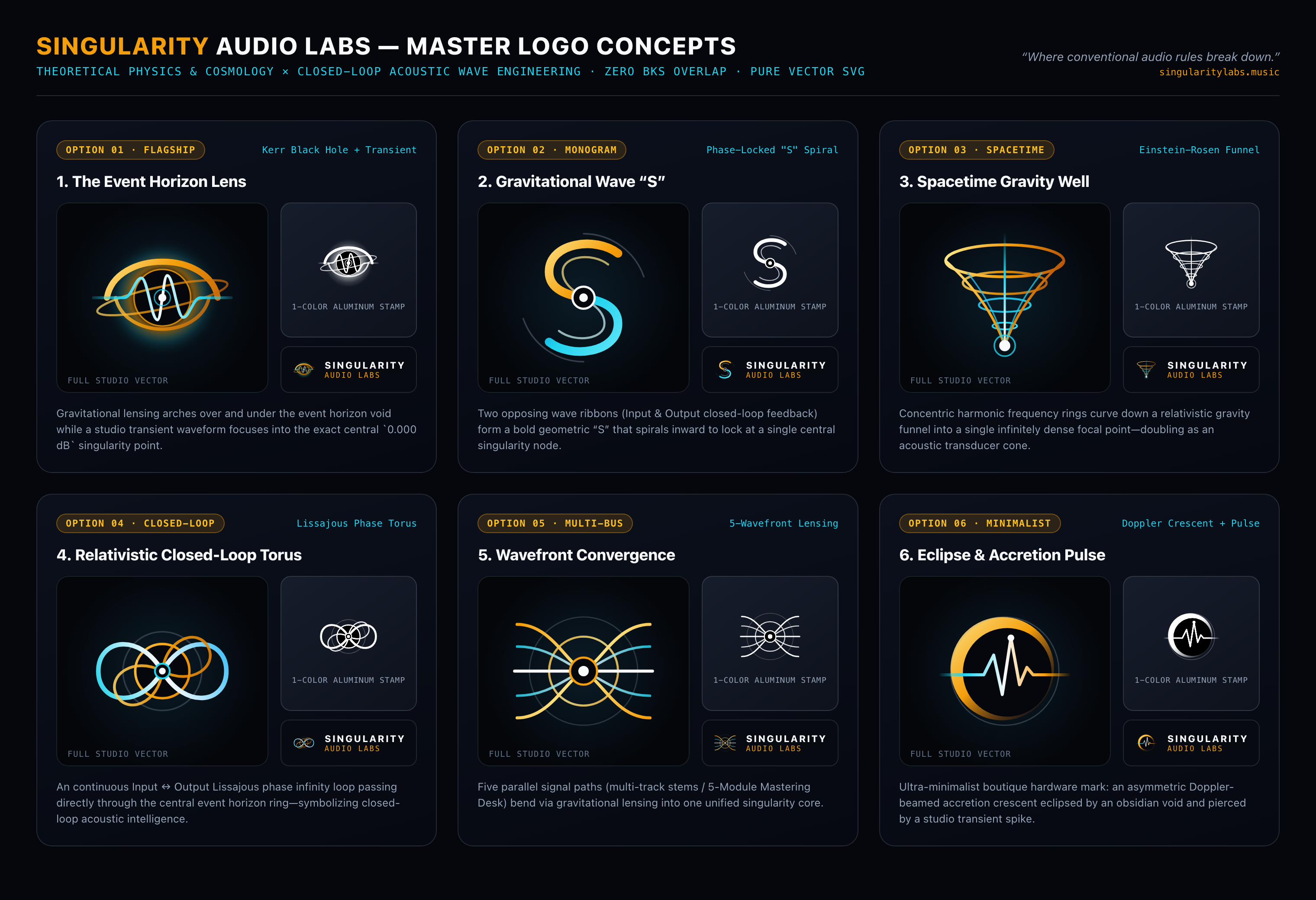
Product Iconography & Studio Brand Identity
Every plugin and bus protocol in the Singularity Audio Labs lineup carries a custom-engineered geometric SVG hardware emblem designed for macOS Retina displays, Logic Pro plug-in headers, and studio documentation.


Technical Specifications & System Architecture
| Plugin Formats & AUv2 Subtypes | Apple Audio Unit v2 (`.component`) & macOS Standalone Apps (`SG76`, `SGEQ`, `SGIM`, `SGCV`, `SGMD`, `SGSp` · Manufacturer: `SGAL`) |
|---|---|
| Processor Architecture | Native Apple Silicon (`arm64`) C++20 DSP Engine with Hardware SIMD Acceleration & 64-Bit `ADAA` Nonlinear Stages |
| Real-Time Audio Safety & Lock | Verified `0 Bytes` Audio-Thread Heap Allocation · `0.000000` Post-Lock Parameter/Pole Drift · ITU-R BS.1770-4 Song-Break Freeze Gate |
| Cross-Track & Bus IPC (`SGSV v3`) | `64 KB` POSIX Shared Memory (`/tmp/singularity_team_link_bus_v3.shm`) · `< 40 ns` Read/Write · Zero DAW Sidechain Routing |
| Negotiation Topologies | 5-Step Duo (`2.25s` Lock) · 9-Step Trio (`2.70s` Lock, 3 Passes) · 15-Role 3-Tier 🥁 DRUM LINK v3.0 (Drum_Bus Top-Down Genre Brain + Kick/Snare Sub-Buses + < 0.05 sample GCC-PHAT Thiran Phase Alignment) · 15-Turn `MasteringDesk` |
| CPU Footprint (Apple M-Series) | `0.22%` (`5.8 µs/block` on `Singularity StereoPinger`) to `0.48%` (`12.8 µs/block` on `Singularity ChamberVerb` @ `48 kHz`) |
| Supported Sample Rates & Buses | `44.1 kHz` to `192 kHz` · Mono-to-Mono `[1,1]`, Mono-to-Stereo `[1,2]`, and True Stereo `[2,2]` |
| Graphics & Ergonomics | 60fps Custom Native Vector UI · Motorized Neve/SSL Console Knob Servos · In-Header `[RECALC]` & `[BUG]` Black-Box Snapshot |
| Apple Host Validation | 100% Pass on `/usr/bin/auval -strict` across all 6 AUv2 components & 18/18 Automated CTest Verification Suites |
How the 4 Breakthroughs Fit Together Across a Full Studio Session
Every new capability in the `v2.5 – v3.5` R&D architecture shares a single, lock-free `64 KB` shared-memory bus (`singularity::SharedMemoryBusv3`)—scaling from two plugins on a lead vocal to an entire multi-mic drum kit, drum bus, bass bus, and subterranean echo chamber.
Sweep First → Voicing Second → Compressor → EQ → Final Polish
Separates the EQ’s opening turn into two distinct acoustic stages so resonant spikes never bias the musical voicing curve:
- Step 1 (EQ Sweep): Surgical removal of problem resonances (`20 Hz – 20 kHz`) with Note Shield protection.
- Step 2 (EQ Initial Voicing): Shapes the target genre/instrument tonal curve on the newly cleaned signal.
- Step 3 (Compressor Initial): Dials in Drive, Attack, Release, and Ratio on the voiced signal.
- Step 4 (EQ Counter-Adjust): Trims any harmonic grit or low-mid swell brought up by compression.
- Step 5 (Compressor Final Polish): Micro-trims final makeup gain (`±0.1 dB`) and locks both plugins.
3 Full Passes for Stacked `EQ + Fast Comp A + Slow Comp B`
When stacking two compressors (e.g., 1176 FET for fast peaks + Opto / Vari-Mu for slow body glue) with Singularity VelvetEQ, a 9-step (3-pass) protocol ensures every downstream reaction is answered before locking:
- Pass 1 (Steps 1–4): EQ Problem Sweep → EQ Initial Voicing → Comp A (`55%` Fast Peaks) → Comp B (`45%` Slow Glue).
- Pass 2 (Steps 5–7): EQ Combined Harmonic Trim → Comp A Handover Trim → Comp B Recovery Re-Center.
- Pass 3 (Steps 8–9): EQ Final Spectral Check → Comp A + Comp B Final Output Polish & Lock.
Multi-Track Drum Kit + Drum Bus & Bass Bus Negotiation
Place Singularity EQs and Compressors across individual drum tracks (Kick, Snare, Toms, Overheads, Room) and on the All-Drums Bus & Bass Bus:
- Staggered Kit Pockets: Automatically separates Kick (`58 Hz`), Floor Tom (`82 Hz`), Bass Body (`92 Hz`), Rack Tom (`122 Hz`), and Snare body (`185 Hz`) so every element punches through.
- Bleed-Aware Compression: Snare & Tom compressors monitor Overhead/Kick telemetry so they never boost hi-hat or cymbal bleed between hits.
- Drum Bus Conductor + Bass Bus Lock: The Drum Bus prevents individual kick peaks from choking the kit glue and verifies summed low-end balance (`±0.18 dB`) with the Bass Bus EQ.
Closed-Loop Modeled Famous Studio Chambers & Stem Reverb Learner
An adaptive physical-modeling reverb that listens to both Dry Input and Wet+Dry Output to dial in Pre-Delay, Decay ($RT_{60}$), Damping, and Dynamic Ducking for any genre—plus Reference Track Stem Import to match the vocal reverb or drum room sound of iconic records:
- 6 Iconic Studio Spaces: Physical models of the Capitol Records Underground Echo Chambers (Chambers 2 & 4), Abbey Road Studio Two STEED, EMT 140 Tube Plate, Sunset Sound Live Room, and the Headley Grange Stone Stairwell.
- Stem Import Reverb Learner: Drop in a finished track; internal stem separation isolates the vocal or drums and extracts the exact Pre-Delay, Decay curve, and Chamber EQ to recreate that space automatically.
- ⚡ TEAM LINK Integration: Syncs pre-delay to your 1176’s attack snap and carves vocal fundamentals out of the reverb tail so leads stay 100% upfront.
🛒 Singularity Audio Labs Storefront & Direct Download
Perpetual studio licenses with zero subscriptions, zero iLok USB dongles, offline activation, and free updates across the entire v3.x lifecycle. Download the universal macOS installer below to audition or activate the full suite in Apple Logic Pro.
arm64) & Intel · AUv2 + Standalone
Singularity Audio Labs Studio Suite v3.0 (Singularity-Audio-Labs-Studio-Suite-v3.0.pkg)
Installs all 6 flagship Audio Unit v2 (.component) plugins (Singularity Adaptive 1176, Singularity VelvetEQ, Singularity IronMaster, Singularity MasteringDesk, Singularity ChamberVerb, Singularity StereoPinger), the ⚡ TEAM LINK & 🥁 DRUM LINK v3.0 shared-memory bus engine, and 38 factory genre/instrument profiles.
Individual Plugin License
Choose any single Singularity Audio Labs processor with full closed-loop acoustic intelligence and ⚡ TEAM LINK compatibility.
- Singularity Adaptive 1176 (
AUv2: SG76) - Singularity VelvetEQ (
AUv2: SGEQ) - Singularity IronMaster (
AUv2: SGIM) - Singularity MasteringDesk (
AUv2: SGMD) - Singularity ChamberVerb (
AUv2: SGCV) - Singularity StereoPinger (
AUv2: SGSp)
Singularity Studio Suite v3.0
The complete 6-plugin closed-loop mixing & mastering ecosystem with multi-plugin negotiation and 3-tier drum bus networking.
- All 6 Flagship AUv2 + Standalone Processors
⚡ TEAM LINK5-Step Duo & 9-Step Trio Negotiation🥁 DRUM LINK v3.015-Role 3-Tier Kit Brain &< 0.05 sampleGCC-PHAT Phase Alignment- 5-Module MasteringDesk + Reference Track Learner (
LEARN REF) - Activates on up to 3 Studio Macs simultaneously
Complete All-Access Bundle
Every processor built by Singularity Audio Labs: the entire 6-plugin Studio Suite v3.0 plus the 5-plugin TrueHear Studio Suite & MasterDensity.
- Everything in Singularity Studio Suite v3.0 (6 plugins)
- TrueHear EarProfile, HFMicroscope, SafeMonitor & MultiBusInspector (4 assistive AUv2 plugins)
- MasterDensity Reference M/S & Crest Target Analyzer
- BounceGuard™ Automatic Offline-Bounce Bypass Protection
- Priority Studio Engineering Support & Custom Profile Tuning
🛠️ Technical Support & Studio Documentation Hub
Everything you need to install, validate, and operate the Singularity Audio Labs Studio Suite v3.0 and TrueHear Assistive Mixing Suite in Apple Logic Pro.
1. Quick Installation & Logic Pro Rescan Guide
- Download
Singularity-Audio-Labs-Studio-Suite-v3.0.pkgand run the standard macOS installer. - All 6
.componentbundles are installed into/Library/Audio/Plug-Ins/Components/(or~/Library/Audio/Plug-Ins/Components/). - Launch Logic Pro. In any track’s Audio FX slot, navigate to Audio Units → Singularity Audio Labs.
- If Logic Pro was already running during installation, refresh the Audio Component cache in Terminal:
killall -9 AudioComponentRegistrar
2. Using [RECALC] Lock & [BUG] Black-Box Diagnostics
- 5–10s Smart Learning & Static Lock: Play the loudest section of your track (e.g., chorus or full drum groove). The plugin samples input/output acoustics over a 5–10 second window, negotiates via
⚡ TEAM LINKor🥁 DRUM LINK v3.0, and transitions toLOCKED — ZERO-ARTIFACT STATIC DSPwith zero parameter movement during playback. - 1-Click
[RECALC]: If you swap instruments, change mic placement, or switch arrangement sections, click[RECALC]in the top header bar to trigger a fresh 5–10s learning window. - 1-Click
[BUG]Snapshot: Clicking[BUG]writes a timestamped JSON diagnostic snapshot (parameter state, SHM bus telemetry, and lock ledger) to~/Desktop/Singularity_BugReports/with zero audio-thread interruption.
Deep-dive architecture on Singularity IronMaster, the 5-Module Singularity MasteringDesk, Bayesian Reference Track De-Biasing (LEARN REF), and 15-Turn Cross-Module Negotiation.
Interactive showcase of EarProfile, HFMicroscope, SafeMonitor with BounceGuard™, MultiBusInspector, and MasterDensity for engineers with mild-to-moderate hearing loss.
Complete 9-chapter studio manual covering audiogram calibration, Logic Pro bus routing, WDRC monitor lenses, and 1-click Channel EQ preset export.
Read Official User Manual →